
Understanding What an AC Freeze-Up Means
An air conditioning freeze-up occurs when the evaporator coil, located inside the indoor portion of the HVAC system, drops below freezing temperatures. Under normal operating conditions, the coil absorbs heat from the indoor air, which causes the refrigerant inside to evaporate. However, if the heat exchange process is interrupted, the moisture that naturally condenses on the surface of the coil turns into ice. This ice acts as an insulator, preventing the system from absorbing heat and causing the ice layer to grow until the unit is encased.
The Role of Airflow and Refrigerant Balance
The stability of an air conditioning system depends on a precise balance between the volume of air passing over the coils and the pressure of the refrigerant within those coils. If the airflow is too low or the refrigerant pressure is incorrect, the thermal balance is lost. When the coil cannot transfer enough heat from the air into the refrigerant, the surface temperature of the metal drops significantly. This imbalance is the fundamental reason behind system icing. Understanding this relationship is the first step in identifying why a system has stopped providing cooling and has instead begun to accumulate frost.
Restricted Airflow as a Primary Cause
Airflow is the most critical factor in preventing ice accumulation on an evaporator coil. At Air In Motion Heating + Cooling, technicians frequently identify restricted airflow as the leading cause of system freeze-ups in residential properties. For the cooling cycle to function, a consistent volume of warm indoor air must pass over the cold evaporator coils. If this flow is obstructed, the refrigerant remains too cold because it has no heat to absorb, leading to rapid ice formation on the coil surface.
Dirty Filters, Blocked Vents, and Fan Issues
There are several common points of failure regarding airflow:
- heavily soiled furnace filter acting as a physical barrier
- closed supply vents or furniture blocking return air grilles
- slipping belt or motor not reaching required revolutions per minute
- mechanical issues with the blower fan itself
Without enough warm air to counteract the freezing temperature of the refrigerant, the moisture in the air quickly turns to ice upon contact with the coil.
Low Refrigerant Levels and System Pressure Imbalance
Another common cause of a frozen air conditioner is an incorrect charge of refrigerant. While it may seem counterintuitive that having less cooling fluid would cause a system to freeze, it is a direct result of physics and pressure changes. When the refrigerant level is low, the remaining fluid must expand more to fill the evaporator coil. This expansion leads to a significant drop in pressure, and as pressure drops, so does the temperature.
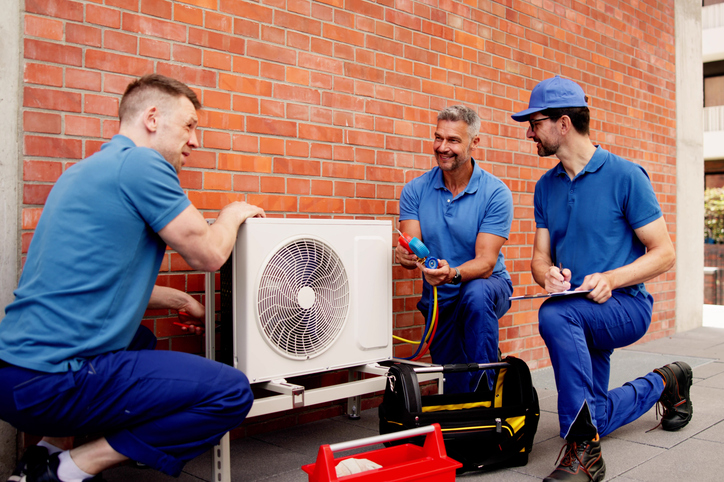
Air In Motion Heating + Cooling utilizes specialized gauges to measure these pressures and determine if a leak is present. If the pressure falls too low, the refrigerant will boil at a temperature well below the freezing point of water. As indoor air passes over the coil, the humidity in that air immediately freezes onto the metal fins.
Leaks, Evaporation, and Cooling Coil Behaviour
Refrigerant does not evaporate or “wear out” like oil in a car; it circulates in a sealed loop. Therefore, low refrigerant almost always indicates a leak within the copper lines or the coils themselves. As the ice builds up, it can cause further damage to the system by putting excessive strain on the compressor. If the ice reaches the outdoor unit through the suction line, it can cause mechanical failure. Professional leak detection and pressure balancing are required to ensure that the system is restored to its engineered specifications and that the freeze-up does not recur after the ice has melted.
Mechanical Failures Leading to Freeze-Ups
Beyond airflow and refrigerant, specific mechanical components must function correctly to ensure the system does not drop below safe operating temperatures. If any part of the control or delivery system fails, a freeze-up is a likely outcome.
Blower Motor and Thermostat Malfunctions
The blower motor is responsible for the constant movement of air. If the motor fails to turn on or if the run capacitor has failed, the evaporator coil will freeze almost instantly because there is zero heat exchange taking place. Thermostat malfunctions can also contribute to this issue. If a thermostat is miscalibrated or has an electrical fault that causes the compressor to run continuously without the blower fan, the system will eventually freeze. In some cases, a damaged contactor in the outdoor unit may stay stuck in the “on” position, causing the cooling cycle to continue even after the indoor fan has stopped, resulting in a solid block of ice within the indoor cabinet.
What Makes Us Unique
Air In Motion Heating + Cooling provides a technical approach to HVAC service that focuses on the physics of the entire system rather than just the visible symptoms. Identifying why a system froze requires a thorough understanding of the relationship between air pressure, temperature, and mechanical integrity.
Accurate Diagnostics for Root Cause Identification
A common mistake is to simply melt the ice and restart the system without identifying the underlying cause. Accurate diagnostics involve measuring the electrical draw of the motors, checking the integrity of the ductwork, and performing a subcool or superheat analysis of the refrigerant. This ensures that the root cause—whether it be a minor leak, a ductwork restriction, or a failing motor—is permanently resolved. By using data-driven diagnostics, we prevent the recurrence of icing issues and ensure the long-term health of the cooling equipment.
Resolving Freeze-Ups Safely and Effectively
When a homeowner notices ice on their air conditioner, the first step is to turn the system off at the thermostat and the breaker to allow the ice to melt naturally. Attempting to scrape the ice off the delicate fins of the evaporator coil can cause permanent damage to the unit.
Professional Inspection and Corrective Measures
A professional inspection is necessary to evaluate the system once the ice has cleared. Technicians will inspect the coils for dirt, check the blower assembly for proper operation, and test the refrigerant pressures. Corrective measures may include deep cleaning of the coils, repairing leaks in the copper lines, or replacing faulty electrical components. Once the system is restored to its proper balance, it can operate efficiently without the risk of future icing.